Why these are one problem seen from two sides
There is a temptation to fix stockouts by ordering more. It works for a week. Then the spare box in the back room turns, eight months later, into an awkward return or a write-off. And fixing expiries by ordering less has the opposite effect: the prescription you cannot fill on the spot.
What connects the two is cover: how many days or months of sales you hold between shelf and back room for each product, compared with how much shelf life those units have left. A product with eight months of cover and six months of remaining shelf life will almost certainly expire. One with three days of cover and three wholesaler deliveries a day in your area may be perfectly fine.
An invented example, just to see the arithmetic. A supplement that sells three boxes a month, with a twelve-month shelf life from manufacture, arrives with eight months left. If you hold twenty-four boxes, that is eight months of sales: the last box will not sell before it expires. With twelve boxes it is four months, and there is margin to spare. Same box, same manufacturer, a different outcome depending on the order.
What the rules say, and what they leave to you
Spanish law says little about how you manage stock and quite a lot about the consequences.
- There is a duty to supply. The consolidated Medicines Act (art. 3) requires pharmacies and distributors to supply or dispense the medicines requested of them and to maintain continuity of service. In the section we were able to consult it sets no specific minimum stock: the quantity is your decision, within your regional rules. A repeated stockout on a fast-moving product is not an automatic breach, but it runs against the spirit of that article and against patient trust.
- Expired product is not sold or reused. The labelling of every medicine includes batch and expiry date, and the same act prohibits dispensing or marketing returned medicines (art. 3.7). A medicine that has left the pharmacy does not go back on the shelf.
- Returns have their own rules. Royal Decree 782/2013 on distribution says wholesalers and manufacturers may only accept returns from the pharmacies they sold the product to, with an exception for returns destined for destruction within integrated waste-management systems. In wholesalers, expired stock goes to a non-conforming area, kept apart from saleable stock. The commercial terms of that return, meaning whether you get a credit, how much and how fast, are set by your own agreement. There is no general rule we can cite.
- End of life goes through SIGRE. SIGRE Points in pharmacies collect expired and surplus medicines and packaging. According to press coverage of its report, 5,397,903 kilos were collected in 2025, 5.16% more than the year before. That is where what patients bring you ends up; your own expired stock is handled through whichever route applies to each case.
Expiry control that works in a real pharmacy
Sophisticated methods fail for a simple reason: nobody has the time. What survives is what fits into a busy counter.
FEFO when shelving
The idea is that whatever expires first goes out first. The warehouse literature sets it against FIFO (whatever arrived first goes first) and notes that FIFO is the more widely adopted because it feels like the natural logic; in industrial batches the two often coincide, but not always. In a pharmacy they stop coinciding when a new batch comes in with an earlier expiry than the box you already have, or when a manufacturer ships two batches at once.
The shelf rule is mechanical: when restocking, the earliest expiry goes at the front and to the right; the new stock goes behind. It is a habit that takes a month to establish and only works if the person restocking reads the date when opening the delivery box. If nobody reads it, FEFO is a nice intention.
The periodic date check
The monthly expiry check is the classic method, and it is still useful. It works better with a fixed day, one zone at a time (one drawer or one bay each week rather than the whole pharmacy on the last day of the month) and a written criterion for what gets pulled: for example, everything expiring within three months goes on a "sell now or return" list, with a threshold you adjust by product type. Three months is only an example; there is no standard figure.
A cheap trick is to mark each box with its expiry month using a coloured marker, one colour per quarter. At a glance you see which drawer is getting close.
Get the date into the software
Visual checks are tiring. What makes them sustainable is the management software recording expiry by batch at goods-in and being able to print a list of what expires within a given window. Not every package, and not every pharmacy, uses this in the same way, and it is common for it to be recorded for only some product families. If your software allows it and you are not using it, it is the first step with the best effort-to-result ratio.
One thing makes capture easier: packs of prescription medicines carry a unique identifier in a two-dimensional code which, under Commission Delegated Regulation (EU) 2016/161, includes the batch number and expiry date as well as the product code and serial number. If the scanner at the counter or at goods-in reads it, that data can reach the software without typing. Whether your software uses it for stock, and not only to verify at dispensing, is a question for your software supplier; we do not assume it.
Cold chain
Fridge products have their own discipline: expiry is not the only date that matters, temperature does too. An electronic shelf label does not measure temperature. What labels can do in that environment is covered on the page about electronic shelf labels for pharmacy fridges.
Stockouts: causes you can watch
Nearly all stockouts fall into three groups.
Badly set minimums. The minimum that was entered three years ago, against the sales of the time. A product that spikes with the season, or with a campaign, leaves the minimum too low. The opposite error exists too: minimums so high that they guarantee surplus.
Medicine supply problems. You do not cause these. The AEMPS explains that they are usually down to manufacturing or distribution problems, that marketing authorisation holders must give advance notice if they foresee an abnormal restriction, and that CIMA lists the affected presentations with their national code and the expected start and end dates, plus those resolved in the last three months. Checking before promising a patient a date saves an awkward conversation. Two things help: ordering the appropriate alternative product where possible, and not stockpiling "just in case" what is under pressure, because that worsens the problem for everyone and later turns into expired stock.
Demand nobody anticipated. An early flu season, an allergy outbreak, a prescription from a new doctor in the neighbourhood. Category management and the campaign calendar help with what can be predicted; the unpredictable needs margin, and margin costs expiries.
Useful software alerts
The ones worth having are few:
| Alert | What it says | What it is for |
|---|---|---|
| Stock below minimum | The product is under the set threshold | Reorder before the stockout |
| High cover | Months of sales in stock exceed a limit | Stop orders, move stock |
| Expiry approaching | Batches expiring within the defined window | Sell, discount or return in time |
| No movement | Product with no sales in N months | Candidate for clearance or delisting |
All of them depend on clean data: real stock, recorded expiry and a sensible minimum. If the software's stock does not match the physical count, alerts are noise; rolling stocktakes by zone keep the two aligned better than an annual count.
What to discount and what not
For a parapharmacy product or a non-prescription medicine with a free price, lowering the price of what is about to expire is usually better than returning it at a loss or throwing it away. If it is reimbursed, the price is not yours to set. A discount with a crossed-out previous price has its own information rules, which we explain in the pricing regulation guide. What matters here is that the discounted price must be the same on the shelf and at the till; errors of that kind are covered in till price errors.
Where electronic shelf labels help, and where they do not
It pays to be clear, because this is where more is promised than happens.
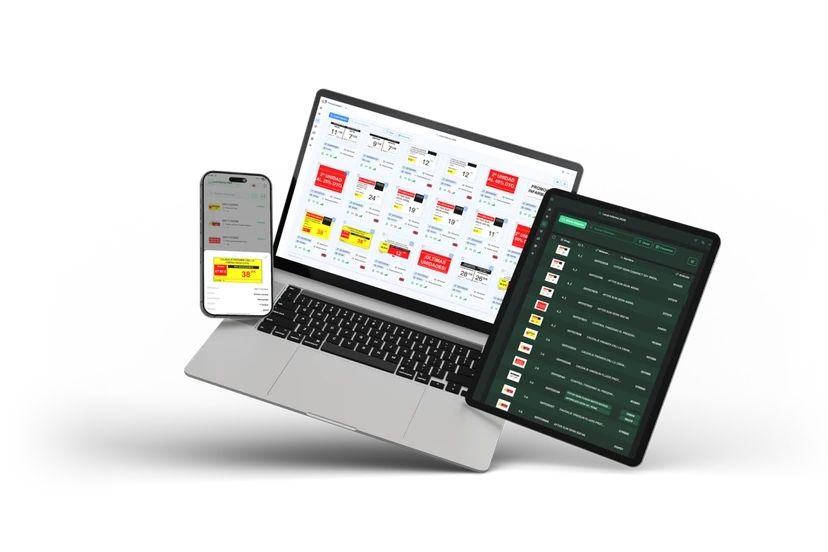
Where they can help. - Expiry discounts. Change the price of a product being discounted on the shelf and at the till at the same time, without printing a sign, and go back to the normal price without having to remember. It is the same mechanism described in changing prices automatically, applied to this case. - Locating. Many labels in the category have an LED that can be lit to point out a specific product on the shelf. FarmaConnect's labels have a seven-colour LED and NFC. Used well, it helps you quickly find the products on the month's expiry list instead of searching drawer by drawer, or flag an urgent restock. Before relying on it, ask where the LED is triggered from (the pharmacy software, a search tool or by hand) and which software it works with. - Shelf alerts for the team. Some labels support an alert for staff (rotation, expiry, stock) synchronised with the software, according to the guide to electronic shelf labels for pharmacies. It depends on the model and the integration.
Where they do not help. - They do not know the expiry date. If the software does not store batch and date, the label cannot warn about anything. - They do not count stock or replace the stocktake. The number they display, if any, is the software's. - They do not fix a badly calculated order. An oversized product will keep expiring under the best label on the market. - They do not measure temperature or guarantee the cold chain. - They do not change the FEFO habit: someone has to put the oldest stock at the front.
For parapharmacy, where expiries on cosmetics, baby food and sun care matter more and prices are free, the case for labels is stronger; it is developed in electronic shelf labels for parapharmacy.
How to start without buying anything
- Pick 30 products: the highest in stock value and the most frequently out of stock. Not the whole pharmacy.
- Measure cover: units in stock divided by average monthly sales. Flag those above six months and those below two weeks. The thresholds are indicative; adjust them by family.
- Check the software: does it store expiry by batch? Can it list by window? If not, ask your supplier.
- Set a check day and a zone.
- Record once a quarter how much expired and how many times something was missing. Without that figure you will not know whether things are improving.
- Decide on technology last. If, after all this, most of the time goes on discounts and searching the shelves, labels make sense; if the problem is ordering, they do not.
Sources
- Texto refundido de la Ley de garantías y uso racional de los medicamentos y productos sanitarios (BOE-A-2015-8343) - Spanish Medicines Act, consolidated text
- Real Decreto 782/2013, sobre distribución de medicamentos de uso humano (BOE-A-2013-10950) - Royal Decree on distribution of medicines for human use
- AEMPS. Problemas de suministro de medicamentos - medicine supply problems
- AEMPS. CIMA, medicamentos con problemas de suministro - CIMA list of medicines with supply problems
- SIGRE. Qué es SIGRE y el Punto SIGRE - what SIGRE and the SIGRE Point are
- The Objective. España recoge 5.400 toneladas de residuos de medicamentos en las farmacias (22-09-2026) - Spain collects 5,400 tonnes of medicine waste in pharmacies
- Commission Delegated Regulation (EU) 2016/161, safety features on medicine packaging
- Shelf life modelling for first-expired-first-out warehouse management (PMC4006170)