That is the core idea. The rest of this guide takes it product by product, because the commonest mistake when signing a promotion or configuring a shelf label is to treat as equal things the law treats as different. A word of caution first: this is a summary of official texts as of November 2026, not legal or pharmaceutical advice, and this version is awaiting review by a registered pharmacist and a lawyer, as explained at the end. It describes Spain only; pharmacies in other countries work under different rules, and we do not compare them here.
Which price rules apply to which product
Start by looking at the shelf rather than the statute. What you see is a mix of four things, and the useful question is who decides the price of each.
| Product | Who sets the price | Can it be discounted freely | Can it be advertised to the public |
|---|---|---|---|
| Reimbursed medicine (prescription or not, inside public coverage) | The authorities: maximum manufacturer price plus margins | No | No |
| Prescription medicine, not reimbursed | Notified-price regime reported to the Ministry | Within the limits of the regime | No |
| Non-prescription medicine, not reimbursed (EFP in Spanish) | Notified-price regime; the manufacturer reports, the pharmacy applies | Within the regime and the discount allowed by Royal Decree 823/2008 | Yes, with conditions |
| Parapharmacy, cosmetics, dietetics | The pharmacy, like any shop | Yes, subject to sale-price and unit-price rules | Yes, under general advertising and health-claim rules |
The table is deliberately simplified. Inside "parapharmacy" there are medical devices and food supplements with their own labelling and health-claim rules, and among medicines there are exceptional cases, such as a health emergency in which the government may set a maximum public price. As a first map, though, it works.
Reimbursed medicines: the PVP is not set at the pharmacy
Article 94 of the consolidated Law on guarantees and rational use of medicines and medical devices says the government sets the criteria and procedure for pricing reimbursable medicines, and that the Interministerial Commission on Medicine Prices (CIPM) sets, with reasons, the reimbursement price of those dispensed on prescription. As a rule, that price is equal to or lower than the manufacturer price outside the National Health System.
The PVP is the authorised manufacturer price, which acts as a ceiling, plus the wholesale distribution margin and the dispensing margin. The law does not quantify those margins; Royal Decree 823/2008 does. In its consolidated text as of 2022, the pharmacy margin is 27.9 % of the pre-tax retail price for medicines with a manufacturer price up to 91.63 euros, and a fixed amount per pack in the higher bands (38.37 euros up to a manufacturer price of 200 euros, 43.37 up to 500, and 48.37 above). The same decree sets the scale of deductions applied to monthly National Health System prescription billing.
What does this mean day to day?
- The Nomenclátor price is the price. The Ministry of Health publishes the official reference, the Nomenclátor, listing which medicines are reimbursed and at what price. If the pharmacy software is kept up to date, the till is right. If a label or a sign shows a different amount, that is an error that costs you in an inspection and in customer trust.
- No offers on reimbursed products. The price of a reimbursed medicine is not a promotion, it is the price. Signing "2 for 1" or "discount" on a medicine covered by public funding has no legal footing, and would also run into the advertising ban discussed below.
- The price changes without the pharmacy doing anything. Price reviews and withdrawals of reimbursement arrive through Nomenclátor updates. Any system that mirrors prices on the shelf must read them from the same source as the till, not from a separate spreadsheet.
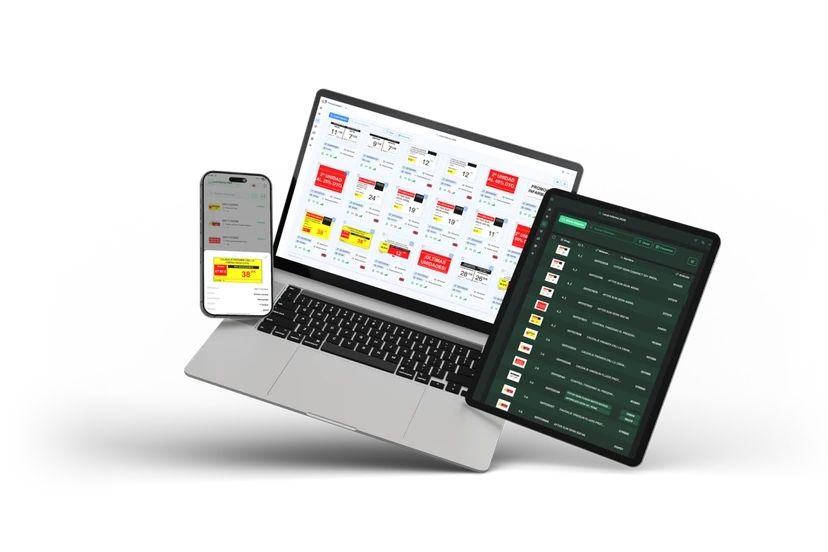
That last point is where electronic shelf labels and regulation meet: a label only helps if it reads the price from the same place as the till. We cover it in the guide to electronic shelf labels for pharmacies and, for the technical side of the connection, in the integrations section.
Over-the-counter (EFP) and non-reimbursed medicines
The regime is different here. Non-reimbursed medicines may be marketed under a notified-price regime: the responsible company reports the price to the Ministry, which may object on public-interest grounds (article 94.4 of the consolidated law). Article 93 adds that while a disagreement is unresolved, the maximum manufacturer price in force stays. For non-prescription medicines, the government may also regulate the pricing mechanism, and in an exceptional health situation the CIPM may set a maximum public price.
"Free pricing" is therefore a phrase to use with care. There is room to manoeuvre, but it is bounded by three things:
- The price notified by the manufacturer and the Ministry's possible objection.
- The amount printed on the pack, which Royal Decree 823/2008 treats as the maximum PVP in its article 4.
- The discount limit set by that same article: up to 10 % off the PVP, taxes included, for the medicines the text calls "advertising" specialities.
Exactly which medicines that article 4 covers today should be confirmed by a pharmacist, because the category of advertisable pharmaceutical speciality has changed name and scope since 2008. It is listed among the points pending validation for this page. The practical rule in the meantime is simple: do not exceed the price printed on the pack, and do not apply discounts you cannot justify from the regulation.
For how to tell EFP from PVP at the counter, and what changes on the sign, see the article EFP and PVP: what is the difference.
Parapharmacy: retail rules, not pharmacy rules
A dermatological gel, a food supplement or a hygiene product is not a medicine and has no regulated price. The same rules apply as in any shop, with two that matter a great deal when prices change often.
The previous price in a sale
Article 20 of Law 7/1996 on Retail Trade says that whenever items are offered at a reduced price, the previous price must be clearly shown next to the reduced one, unless the items are being sold for the first time. It also defines "previous price": the lowest price applied to identical products in the preceding thirty days. This wording came with Royal Decree-Law 24/2021, which transposed the EU Omnibus Directive. The general explanation for any retailer is in the pricing regulation guide on etiquetaselectronicas.io, which we do not repeat here.
What deserves a closer look is the pharmacy case. Say a sunscreen sat at 18.90 euros for three weeks, dropped to 15.90 for ten days, and you now want to advertise it as reduced. The previous price you must show is not 18.90 but 15.90, because that is the lowest in the thirty days. Many pharmacy promotions fail exactly there: the "catalogue" price is reused as if it were the previous one. With paper labels the mistake is human; with an electronic system the fix is for each item's price history to be available and the figure calculated automatically, but that depends on the software and the integration, not on the label.
Does the same article apply to a discounted non-prescription medicine? The law speaks of "articles" and makes no distinction, but medicines have their own pricing and discount framework, so we do not treat the answer as settled. It is one of the questions we leave for the pharmacists' association to review.
The unit price
Royal Decree 3423/2000 requires the selling price on every product offered to consumers, and the unit price on those that must declare a quantity. It defines the unit price as the final price, taxes included, per kilo, litre, metre, square metre or cubic metre, or per the unit set in its annex II. For food supplements and cosmetics, that annex sets 100 grams or 100 millilitres.
Two exceptions come up daily in a pharmacy: no unit price is required when it equals the selling price, and annex I exempts products under 50 grams or millilitres. So a 250 ml shampoo needs it and a 30 ml lip balm does not.
Prices must be unambiguous, easy to identify and clearly legible, in the same field of vision and visible without the customer having to ask (article 4.1). The same decree states, in article 1.3, that for medicines their specific rules apply. On an electronic label this becomes a concrete design decision: space must be reserved for the unit price on the items that need it, and small displays cannot always fit it without sacrificing legibility.
Advertising: what may and may not be promoted
The question that raises most doubts is this: you may sign a price, but may you advertise? They are two different things, and the difference decides which sign is lawful.
Article 80 of the consolidated law only allows advertising to the public of medicines that:
- are not funded from public money,
- can be used without medical diagnosis or follow-up (except vaccination campaigns),
- and are not psychotropic or narcotic substances.
The message must be clearly identifiable as advertising, say that the product is a medicine, and recommend consulting the pharmacist. The law forbids promising a cure, using testimonials and citing health authorisations as an argument. It also bans bonuses, gifts and contests tied to the sale of medicines, a point that bears directly on counter promotions and some arrangements with manufacturers.
The detail is in Royal Decree 1416/1994. Among other things it excludes from public advertising prescription-only medicines and those included in the National Health System pharmaceutical benefit (article 7), requires the message to include the medicine's name, the essential information for rational use and an explicit invitation to read the leaflet, and forbids, for example, suggesting that the medicine guarantees its effect, improves health, or is equivalent to a food or a cosmetic (article 6). It also bars certain indications from public advertising, such as diabetes, cancer or chronic insomnia.
There is a tension worth stating plainly. The 1994 text speaks of prior authorisation of advertising (article 22), while article 80 of the later consolidated law says non-prescription medicines do not need prior administrative authorisation, though they remain subject to controls. If you have read somewhere that "authorisation is required" and elsewhere that "it is not", both may be quoting the right rule for their moment. For a specific advert, the place that settles it is the health authority of your autonomous region.
Where the line falls on a sign or a screen
For whoever puts up the signs, the practical translation is short:
| Situation | General assessment |
|---|---|
| Showing the price of a reimbursed medicine on the shelf | Price information, not advertising; no promotion or slogan |
| Advertising a prescription medicine with a slogan or discount | Not allowed |
| Advertising a non-reimbursed non-prescription medicine with promotional wording | Possible, meeting article 80 and RD 1416/1994 |
| Gift, prize draw or contest linked to buying a medicine | Prohibited by article 80 |
| Promoting parapharmacy with previous and reduced price | Allowed under the previous-price and health-claim rules |
Borderline cases exist and are covered in more detail in the article how to advertise a medicine without breaking the rules. For in-store screens and what to show on them, see the digital signage guide, and if a manufacturer pays for the content, the retail media guide, where the limits above bite harder.
A change on the way, with no date yet
Royal Decree 1416/1994 predates the internet and in-store screens. In March 2023 the Ministry of Health opened a prior public consultation to replace it with a new royal decree, with changes that include digital advertising. As of this guide we have not confirmed that it has been approved, and the text in force is still the 1994 one. If that changes, the guide will be updated, which is why it carries a date.
Regional rules: what this guide cannot give you
Control of health advertising and pharmacy regulation is a competence shared between the State and the autonomous regions. In practice, it is your region's health department or inspection service that visits, and some pharmacists' associations publish their own criteria on price display, exterior signs or use of screens. We could not verify in official sources what specific criteria exist in each region, so we do not cite them. The honest thing is to tell you whom to ask: your official pharmacists' association and, for a specific advert, the regional directorate for pharmaceutical regulation or its equivalent.
A checklist before signing or programming labels
This list does not replace the analysis above, but it prevents the usual stumbles.
- Classify each item as reimbursed, prescription not reimbursed, EFP or parapharmacy, and make sure your pharmacy software knows.
- Take the price from a single source. What comes out at the till is what must be seen on the shelf.
- No promotions on reimbursed items or on anything that needs a prescription.
- For parapharmacy sales, keep the thirty-day history and calculate the previous price from it.
- Check the unit price on items with a declared quantity and reserve a visible spot on the label.
- If you advertise an EFP, include the advertising statement, the invitation to read the leaflet and the reference to the pharmacist, and offer no gifts linked to the purchase.
- Ask your association about regional criteria before launching a campaign with screens or exterior signs.
What this guide does not cover
It does not cover the labelling of the products themselves (leaflet, pack, summary of product characteristics), the handling of patient data, or distance-selling rules, which have their own framework. Nor does it deal with the price of electronic labels, covered on another page, or with price rules for shops that are not pharmacies, whose reference is the guide on etiquetaselectronicas.io.
Review status
This guide is an editorial summary based on consolidated BOE texts and Ministry of Health sources. It is awaiting review by a registered pharmacist and by legal counsel, and until that review appears in the header it should be read as guidance and not as a compliance standard.
Sources
- Real Decreto Legislativo 1/2015, texto refundido de la Ley de garantías y uso racional de los medicamentos y productos sanitarios (BOE)
- Real Decreto 1416/1994, por el que se regula la publicidad de los medicamentos de uso humano (BOE)
- Real Decreto 823/2008, por el que se establecen los márgenes, deducciones y descuentos correspondientes a la distribución y dispensación de medicamentos de uso humano (BOE, texto consolidado)
- Ley 7/1996, de Ordenación del Comercio Minorista, artículos 20 y 24 (BOE, texto consolidado)
- Real Decreto 3423/2000, por el que se regula la indicación de los precios de los productos ofrecidos a los consumidores y usuarios (BOE)
- Ministerio de Sanidad: consulta pública previa del nuevo real decreto de publicidad de medicamentos de uso humano (marzo 2023)
- Spanish Ministry of Health: Nomenclátor medicines database (prices and reimbursement status)