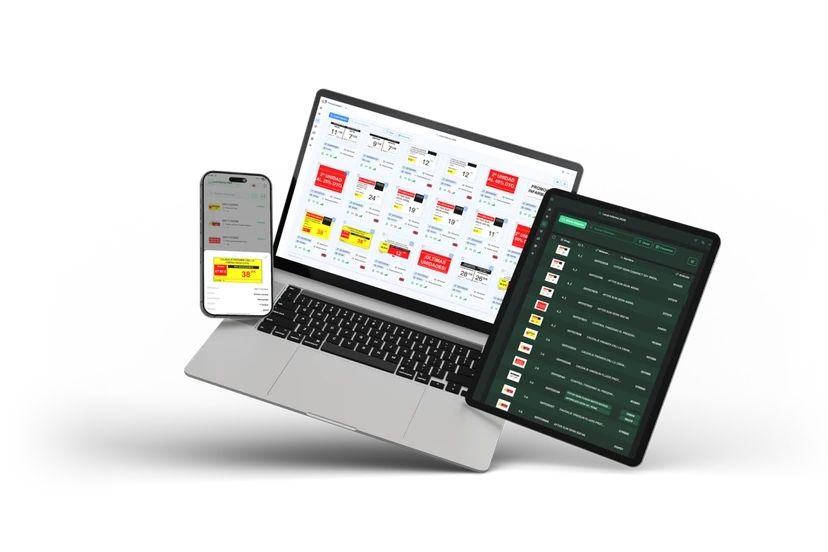
That is the short answer. The long one has to do with the poster in front of you, the screen at the counter and the offer a manufacturer puts on the table. This article goes through those cases one by one. The general framework for prices and advertising is in the guide to pharmacy pricing and advertising rules; here we stay with what gets decided day to day.
A caveat before going on: this is a summary of official texts, not legal advice. It still needs review by a registered pharmacist and a lawyer, and each autonomous community has its own inspectorate. The rules cited are national, published in Spanish in the official gazette (BOE); the official names are kept in the original language.
What the law says: two overlapping texts
For advertising aimed at the public you have to read two rules side by side, plus one underlying principle that runs through both.
Article 80 of the consolidated Medicines Guarantees Act (Real Decreto Legislativo 1/2015) sets who may be advertised and under what conditions. It is the statutory rule and the more recent of the two.
Royal Decree 1416/1994 develops that regulation in detail: minimum content of the message, specific prohibitions, indications that may not be mentioned. It dates from 1994 and, although amended in places (article 4 changed in 2010 to point to the current law), it remains the reference text. In 2023 the Ministry of Health opened a prior public consultation to replace it with one that covers digital advertising; we have not found that it was approved.
The summary of product characteristics as the limit. Article 2 of the royal decree requires every element of an advert to match the summary of product characteristics (ficha técnica) and the medicine to be presented objectively, without exaggerating its properties.
First filter: which medicine are we talking about
Before thinking about the advert's design, check the product. Article 80.1 requires all three conditions at once:
| Condition | What it means in practice |
|---|---|
| Not funded with public money | If the medicine is in the National Health System benefit, it is out, even if sold without prescription |
| Designed for use without medical intervention | No diagnosis, prescription or follow-up, though a pharmacist may be needed; approved vaccination campaigns are the exception |
| Neither psychotropic nor narcotic | As defined by international conventions |
Article 7 of the royal decree repeats it in other words: prescription-only medicines, those containing psychotropic or narcotic substances, and those that are part of the National Health System pharmaceutical benefit are excluded.
One consequence surprises people. If a medicine is reimbursed, it cannot be advertised even without a prescription. And the reverse: being sold without a prescription does not make a product advertisable. All three conditions apply together, and they are checked product by product.
Second filter: what the advert must carry
If the medicine passes the first filter, the message has to meet the requirements of article 80.2 and article 5 of the royal decree. An advert for a non-prescription painkiller, for instance, needs:
- A clear sign that it is advertising and that the product is a medicine.
- The name of the medicine and, if it has a single active substance, its common name.
- The information essential for using it properly.
- An express, visible invitation to read the leaflet or the packaging.
- The statement "if in doubt, consult your pharmacist" or similar.
And it may not include (article 6 of the royal decree, among other things):
- promises of a cure or of no side effects;
- comparisons that present it as better than, or equal to, another treatment;
- testimonials or endorsements by celebrities or health professionals whose fame could encourage consumption;
- messages aimed exclusively or mainly at children;
- the argument that it is "natural" as a guarantee of safety or efficacy;
- equating it with a food, a cosmetic or another consumer product;
- descriptions of symptoms so detailed that they invite false self-diagnosis;
- any mention that it has health authorisation or any other authorisation, or its registration number.
In addition, advertising to the public may not refer to certain conditions: tuberculosis, sexually transmitted diseases and other serious infectious diseases, cancer, chronic insomnia, diabetes and other metabolic diseases.
The exception for reminder adverts
Article 5.2 allows an advert that only recalls the name of the medicine, without the rest of the content, on two conditions: it must be sufficiently well known to the public and it must have been in promotional campaigns for at least two years. It is a narrow door. A recent launch cannot use it.
Pharmacy cases, one by one
The manufacturer's poster in the window
A manufacturer sends you a poster for a non-prescription painkiller to put in the window. If the product meets the three conditions and the poster carries the mandatory statements, the content is acceptable. If the invitation to read the leaflet or the line about consulting a pharmacist is missing, the poster is incomplete. The manufacturer having designed it does not fix that: the offence of advertising in breach of the law is not limited to whoever prints the poster, and a pharmacy displaying it in its window is also spreading it. How an inspection would share out responsibility in a given case is a question for your legal adviser; the practical step is to check it before you put it up.
The counter screen
A screen is a medium like any other: what a poster cannot say, a video cannot say either. Two practical points:
- The content rotates. A ten-slide loop can mix a sunscreen (parapharmacy, outside this regulation) with a cough syrup (a medicine, inside it). The medicine rules apply to the syrup slide, not to the whole loop. The law also sets accessibility conditions for messages in audiovisual form.
- If someone pays for the slide, it is advertising all the more. The same limits apply, and other issues come into play that the guide to retail media in pharmacy covers. What to put on screen without wandering into delicate territory is detailed in the digital signage guide.
The price of a reimbursed medicine on the shelf
Displaying the price of a reimbursed medicine is price information, not advertising: article 1.4.c of the royal decree leaves price lists and catalogues outside its scope as long as they carry no information about the medicine. What does not fit is dressing it up with "offer", "discount" or a slogan. As soon as the price comes with a message inviting people to buy, it stops being a price list.
A health message that does not name the medicine
Article 1.4.d likewise leaves out of scope information about human health or disease, provided there is no reference at all, not even indirect, to a medicine. A panel on how to ease seasonal allergy symptoms, or on staying hydrated in summer, can go up without passing through this regime. But "not even indirect" carries weight: if the panel ends with the logo of an antihistamine brand, it is no longer just information.
The free gift, the 2-for-1 and the prize draw
Article 80.5 bans bonuses, gifts, prizes, contests, rebates or similar incentives linked to promoting or selling these medicines to the public. A free toiletry bag with a cough syrup, a draw among buyers of a flu remedy, or a loyalty card whose points accrue only on one medicine all fall squarely within it. Breaching this ban is a defined offence and, as we will see, among the very serious ones.
The discount
Here the rule is subtler. Medicines that may be advertised carry a price printed on the pack which the eighth additional provision of the consolidated act treats as the maximum retail price, and it leaves the maximum discount a pharmacy may apply to later regulation. If you do discount, article 15.4 requires the receipt to show the discount applied. We could not verify the limit currently in force, so ask your professional college (colegio oficial de farmacéuticos) before displaying a percentage. And remember that the list of offences includes offering discounts "as methods linked to promoting or selling" these products.
The free sample at the counter
Article 8 of the royal decree prohibits direct distribution of medicines to the public for promotional purposes. Handing customers samples of an advertisable medicine is not a harmless commercial gesture.
If you are ever inspected
The penalty regime is in articles 111 and 114 of the consolidated act. Three offences matter here, and all three are classed as very serious:
- promoting, informing about or advertising medicines in breach of the law or of general advertising legislation;
- advertising to the public products with medicinal purposes that are not authorised as medicines;
- offering bonuses, gifts, prizes, contests, rebates, discounts or similar incentives as a method of promoting or selling these products.
Fines for very serious offences run from 90,001 euros at the minimum grade up to 1,000,000 at the maximum, and may exceed that by up to five times the value of the products or services concerned. The law adds confiscation of the illicit profit. These are the statutory bands; the actual penalty depends on negligence, intent, turnover and other factors.
A four-question check
Before putting up an advert, poster or slide featuring a medicine:
- Is it reimbursed, prescription-only or psychotropic? If yes to any, it is not advertised.
- Does it carry the five statements? Identified advert, name, usage information, invitation to read the leaflet and advice to consult the pharmacist.
- Does anything promise, compare, endorse by fame or appeal to "natural"? Take it out.
- Is it tied to a gift, draw or promotion? Take it out, and ask first if it is a discount.
If the content is doubtful, do not publish until you have asked. The same approach works for parapharmacy promotions, which follow different rules and are covered in the article on what to move on the shelf without forcing the sale and on the page about electronic shelf labels for parapharmacy.
What this article does not settle
- Whether prior authorisation is needed. The consolidated act says non-prescription medicines do not require it, with checks afterwards, while the 1994 royal decree keeps the authorisation regime in its article 22. We have no official source that closes the discrepancy for each autonomous community, which is why a specific advert should be checked with your own health authority.
- Medical devices have rules of their own. Article 80 excludes, for example, direct or indirect advertising of those funded by the National Health System.
- Food supplements, cosmetics and products with supposed health properties are outside this article.
The quality of a poster is decided in five lines of small print that almost nobody reads, until someone checks them. That check is best done by a person, a pharmacist, before the inspector arrives. For the technical side of shelf pricing, the guide to electronic shelf labels for pharmacy explains what can be automated and what remains a human decision.
Sources
- Real Decreto Legislativo 1/2015, texto refundido de la Ley de garantías y uso racional de los medicamentos y productos sanitarios (BOE)
- Real Decreto 1416/1994, por el que se regula la publicidad de los medicamentos de uso humano (BOE, texto consolidado)
- Real Decreto 109/2010, que modifica el artículo 4 del Real Decreto 1416/1994 (BOE-A-2010-2696)
- Ministerio de Sanidad: consulta pública previa del nuevo real decreto de publicidad de medicamentos de uso humano (marzo 2023)
- AEMPS, legislación sobre publicidad