A 30-euro ticket with 2.4 items
IQVIA's December 2025 trends report puts the average ticket of the Spanish pharmacy at 30.1 euros, with 2.4 units per ticket and around 789 people visiting each week. These figures are a compass, not a target: they blend prescription medicines, which the customer does not choose, with consumer products, which they do. The same report splits turnover into 69% medicines and 31% Consumer Health.
That split changes how to look at the question. With reimbursed prescription medicines there is little to decide and little to move. Customers compare, hesitate and ask questions in the consumer part: dermocosmetics, hygiene, nutrition, parapharmacy and freely priced OTC products. Nearly all cross-selling opportunities sit there, and so does nearly all the risk of overdoing it.
A sense of scale: going from 2.4 to 2.6 units per ticket looks small. Applied to hundreds of transactions a week at the till, it is not. But a poster will not get you there; dozens of small, well-placed decisions will.
What good cross-selling is, and what it is not
Cross-selling in a pharmacy is not an "anything else?" aimed at everyone who walks in. It is recognising that a need rarely comes alone. Someone buying an oral antihistamine for allergic rhinitis may be glad to hear that nasal rinses exist; someone picking up sunscreen for the first trip of the year may not have thought of after-sun or lip protection.
A simple test before suggesting anything: would you say it just the same if the complementary product had zero margin? If yes, it is advice. If the answer changes with the margin, it is selling.
Some pairs that usually make clinical sense, with no guarantee of outcome (they depend on each patient and must go through professional judgement):
| Need the customer brings | Complementary product that makes sense | When not to suggest it |
|---|---|---|
| Facial sunscreen | Gentle cleanser, night moisturiser | If they already use a full routine, or reactive skin has not been assessed |
| Nappies or baby hygiene | Nappy cream, fragrance-free wipes | If they ask about another specific product and are in a hurry |
| Iron or vitamin supplement | Explaining how and when to take it (advice, not a second product) | If they take other medication and the pharmacist has not checked interactions |
| Antiseptic for a minor wound | Dressings in the right size | If the wound needs medical assessment |
| Thermometer | Spare batteries or covers | Almost always unnecessary: do not insist |
The last row is there on purpose. Some pairs look logical in a spreadsheet and feel heavy at the counter.
Ethics: where the line is
A pharmacy is a healthcare establishment and a shop at once. That dual nature is what makes cross-selling delicate, and it is worth being clear about before designing anything.
The patient decides, the professional informs. The pharmacist-led advice service ("indicación farmacéutica"), as described in SEFAC's good practice guidance, starts from a patient's consultation and requires judging whether the problem fits self-care or should be referred. If the symptom calls for a doctor, no complementary product is relevant. For the wider question of what may be said about a medicine, see what can be advertised for a medicine.
With a prescription, no pressure. People collecting a prescribed treatment tend to arrive worried or in a rush. Offering something extra is legitimate when it is justified (a form of administration, a device, a supplement the doctor mentioned); pushing an unrelated consumer product is the pattern that erodes trust.
Manufacturer incentives must not decide what you recommend. Article 17 of Royal Decree 1416/1994 prohibits giving, offering or promising bonuses or advantages to those who prescribe or dispense medicines as part of their promotion, except for objects of insignificant value that are irrelevant to pharmacy practice. Article 19 also forbids those professionals from requesting or accepting them. The consolidated Medicines Act (Royal Legislative Decree 1/2015) contains a prohibition of incentives along the same lines. If a manufacturer offers your team a bonus for pushing its product, that is not a sales-technique question: take legal advice or ask your professional college. An incentive that ends up resembling payment for recommending is exactly what the rule is there to prevent. The nuances (what counts as a medicine, what as a medical device or cosmetic) must be confirmed by a pharmacist or a lawyer; here we only mark the direction.
Transparency with promotions. A "2 for 1" or a bundle at a special price is legitimate parapharmacy selling, but the price and the condition must be clear. If you are unsure how to communicate discounts and reference prices, see the guide to pricing and advertising rules.
A rule you can adopt with your team: the team may propose a complementary product once. If the customer declines, nobody insists.
Placement: the shelf gives advice too
An important part of cross-selling is not done by a person at all; it is done by the distance between two products. Some ideas that work in small shops and are worth testing in yours:
- Complementary next to the main product. Not in another aisle, even if the planogram looks "tidier". Someone looking for sunscreen will not go off to find the after-sun on their own.
- A small "made for this" zone. A niche beside the till or counter, with three or four seasonal solutions (travel, allergy, back to school). Better little and refreshed than a lot and static.
- Height and legibility. What sits at eye level gets seen before anything that means bending down, and what is not seen is not bought. Keep that level for what you really want looked at, not for the product with the most stock.
- Watch the hot zones of campaigns. If you give the window or an end-of-aisle display to a manufacturer, decide beforehand how that coexists with your recommendation criteria; the underlying debate is in the guide to retail media in pharmacies.
- Screens, only if they add something. A screen at the point of sale can remind customers that the complementary product exists, but there are limits on content and on what it may say; what to show on digital signage explains them.
This article sticks to small tactics. How to divide the floor space and categories of the whole pharmacy is a bigger decision, covered in pharmacy category management.
Price matters too
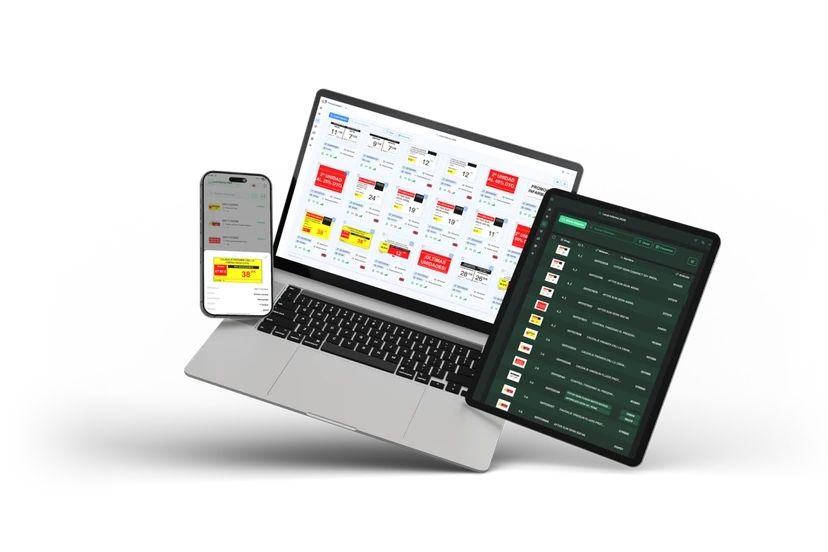
Complementary products often fail for an unglamorous reason: the shelf price does not match the till, or the offer has ended and nobody has removed the sign. A mismatch on an item the customer was not going to buy costs more than not having displayed it. If you use electronic shelf labels, the practical benefit is that the main and the complementary product show the same price and promotion as the management software, with no one walking the shelves with a tablet. More detail in the guide to electronic shelf labels for pharmacies and, for the area where they are used most, in electronic shelf labels for parapharmacy. They do not replace advice; they only stop a wrong price from spoiling it.
How to measure without fooling yourself
Measuring badly is worse than not measuring, because it gives licence to leave everything as it is or to keep doing what does not work. A minimal approach:
- Pick one pair of products, not the whole shop. For example sunscreen and after-sun, or a supplement and its companion.
- Define three numbers. Average ticket across the pharmacy, units per ticket and, above all, the attach rate: of all tickets containing product A, what percentage also contain B.
- Compare with a like-for-like period. The same month last year, or earlier weeks with the same seasonality. July compared with April proves summer, not your shelf.
- Change one thing at a time. If you move the placement, add a sign and train the team in the same week, you will not know what worked.
- Review for at least four weeks. Less, and the noise of good and bad days takes over.
- Note what the till does not show. Complaints, returns of the complementary product and team comments count as indicators. If the ticket rises and returns rise too, the increase was false.
Most pharmacy management systems can pull tickets by product; a pair report may need a manual cross-check or an extra tool depending on the software. Ask your supplier before assuming it comes out on its own.
What to change this month
If you only touch one thing, make it this: choose two product pairs with clear clinical logic, place them together, tell the team when to suggest and when not to, and measure for four weeks. It is unspectacular and can be reversed in an afternoon. After that, decide whether it is worth expanding.
And a final warning: a higher ticket is not always a better pharmacy. A ticket that rises because the team recommends with judgement shows up in loyalty. One that rises at the expense of trust is paid for later.
Sources
- IQVIA, Informe tendencias del mercado farmacéutico retail, diciembre 2025
- BOE, Real Decreto 1416/1994, por el que se regula la publicidad de los medicamentos de uso humano
- BOE, Real Decreto Legislativo 1/2015, texto refundido de la Ley de garantías y uso racional de los medicamentos y productos sanitarios
- SEFAC, Buenas prácticas del servicio de indicación farmacéutica