A note on terms for readers outside Spain. Spanish pharmacies sell prescription and reimbursed medicines, and most also run a parafarmacia section: non-prescription health, beauty and baby products sold at prices the pharmacy sets itself. The owner is the titular, who must be a licensed pharmacist. Category management applies mostly to the second part of the business.
Why it matters in a specific pharmacy
In IQVIA's snapshot of the Spanish pharmacy, with data up to December 2025, Consumer Health (what IQVIA groups outside medicines: OTC, patient care, personal care and nutrition) accounts for 31% of average turnover, with medicines making up the other 69%. The average ticket is around €30.1 for 2.4 units, and an average pharmacy serves about 789 people a week. Within Consumer Health the split is 47% OTC, 27% patient care, 17% personal care (where dermocosmetics sit) and 9% nutrition.
Two ideas follow from those figures, and they shape everything else. First, most of that 69% comes through a door the owner barely controls, because the retail price of reimbursed medicines is fixed and demand is driven by the prescription. Second, the room to manoeuvre lies in the remaining 31%, and that is where a metre of shelf allocated well or badly changes the result. These are averages from a sample of 7,000 pharmacies; yours may look quite different, which is why the first job is to look at your own numbers.
Step 1: define the categories
Before dividing anything up you have to decide what a category is. The useful criterion is not the supplier's or the wholesaler's but the purchase decision: group what the customer sees as interchangeable or complementary. Someone looking for sunscreen compares sunscreens, not a sunscreen and a shampoo, even if both come from the same manufacturer.
A reasonable starting list for a pharmacy with a parapharmacy section might be:
- Sun care and after-sun
- Facial skincare (anti-ageing, moisturising, acne)
- Body and hair care
- Oral hygiene
- Baby and maternity
- Nutrition and supplements (vitamins, immune support, sleep)
- Orthopaedics and small medical supplies
- OTC by indication: pain, digestive, cold and flu
- Weight control, foot care, optics and other niche lines
Keep the list to one page. Splitting too finely produces categories with three products in them and nothing to analyse.
Step 2: give each category a role
The most widely used framework in retail gives every category one of four roles. DotActiv describes it, among others: destination, routine, seasonal and convenience. Applied to a pharmacy, it works like this.
| Role | What it does for the pharmacy | Plausible example | How it is managed |
|---|---|---|---|
| Destination | The reason people choose you over another pharmacy | Dermocosmetics if you are known for advice; infant nutrition if your neighbourhood is young | Best location, deep range, team advice, prices watched |
| Routine | Covers frequent needs and brings customers back | Oral hygiene, painkillers, nappies | Constant availability, competitive price, no over-investment in space |
| Seasonal | Adds movement at a particular moment | Sun care in spring and summer, cold and flu remedies in autumn and winter | Space that grows and shrinks, hot-zone display, withdrawn on time |
| Convenience | Completes the basket and usually adds margin | Accessories, small supplies, impulse items at the till | Few products, near the point of payment, higher margin |
A warning about this table: it is a framework, not a truth. Roles are not universal, because they depend on who shops in your area. Dermocosmetics is a destination in a pharmacy in a well-off urban district where customers ask about treatments, and a convenience item in a village pharmacy where someone buys a cream when theirs runs out. That is why copying another pharmacy's roles is of little use, while deciding them from your own data and from what the counter team knows is worth a great deal.
Step 3: allocate space without fooling yourself
A common mistake is to share out the shelves in proportion to sales. It looks logical and almost never is, because it ignores two things: not all space is worth the same (eye level, proximity to the counter and the path to the prescription area are worth more than the back wall), and each category responds differently to extra room. A well-stocked routine category does not sell more because it gets another half metre; a seasonal category in its peak month does.
One sensible way to approach it:
- For each category, calculate gross margin per linear metre (or per shelf) and sales per linear metre, using your last twelve months of sales.
- Mark the categories with a destination role and secure them a prime location even if their sales per metre are not the highest: they are there by strategy.
- Reduce the space of routine categories whose stock persistently exceeds their stock turn, and redesign the convenience space around the till.
- Keep a variable slot, one that changes with the season, for seasonal categories.
An example with invented figures, only to show the mechanics. If one category generates €9,000 of margin a year on 3 metres, it earns €3,000 per metre; another produces €7,200 on 1.2 metres, or €6,000 per metre. Before moving half a metre from the first to the second, check that the second has not hit its ceiling (that its products are not already selling out mid-month) and that the customer is not losing something that brings them into the shop. The calculation points the way; the decision still belongs to the person who knows the premises.
Space is also negotiated vertically. Eye-level facings are for what you want to sell, low shelves for what the customer already comes to find, and hand height for impulse purchases. A pharmacy also has areas that are not commercial although they look it: the route to the counter, the waiting area, the display beside the person paying. It is worth deciding consciously what goes in each.
Step 4: from allocation to planogram
A planogram is the shelf plan that says which product goes where and with how many facings. In a medium-sized pharmacy you do not need specialist software to have one; what you need is to have one, because without it the shelves drift in a few weeks and nobody can tell whether what they see is a decision or an oversight. A useful planogram sets out:
- The reading order, left to right and top to bottom, with brands grouped by purchase criterion (skin type, age, indication) before manufacturer.
- The number of facings per product, with a minimum high enough for stock to be visible and a maximum so that no product takes up more room than it sells.
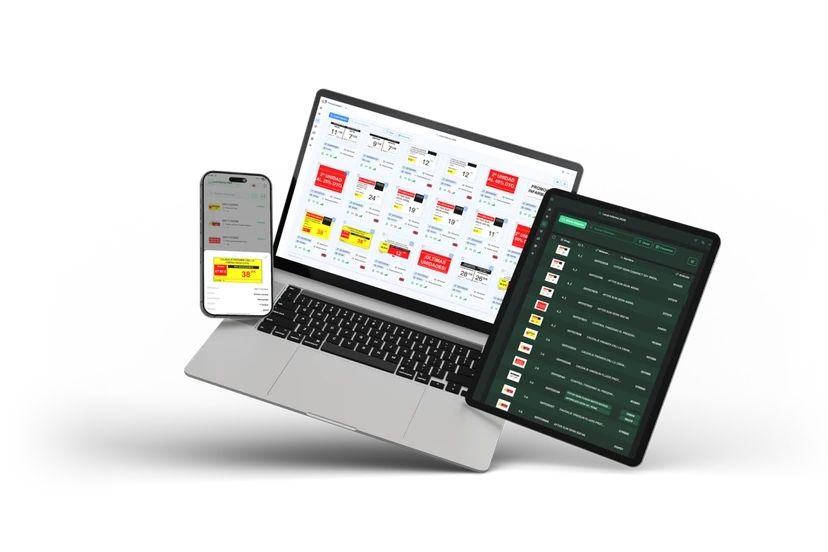
- A place for prices. This is where electronic shelf labels come in: the shelf price matching the till price is a basic condition, and being able to change a whole planogram without reprinting every shelf-edge ticket makes seasonal resets cheaper. If you have a large parapharmacy, this parapharmacy label service sets out what a label can do in that part of the shelf.
This is where good work shows most and where it is most often abandoned. A planogram with no review date turns into a memory.
Step 5: read stock turn the way you read a patient
Stock turn is the number of times a product's stock is sold and replenished in a period. It is the measure that best shows which categories work, and also the easiest to misread when you are in a hurry.
Three cautions for reading it well:
- Stock turn without margin misleads. A product that turns fast on a tiny margin can eat space and working capital while leaving nothing behind. The useful reading crosses turn and margin: what turns and earns is defended; what turns without margin is traffic (does it bring people in?); what earns but does not turn ties up cash; what neither turns nor earns is questioned.
- Seasonality distorts averages. The annual stock turn of a sun cream gives a figure that describes neither April nor December. Compare each seasonal category with its own same month a year earlier.
- A stock-out looks like poor turn. If a product is out of stock for two weeks, its average turn falls and it seems customers no longer want it. Check availability first.
On data, almost all pharmacy management systems can export sales by family and product; getting the figures is rarely the hard part, and giving them a coherent category almost always is. An afternoon spent cleaning up the families is worth more than any dashboard built afterwards. Which stock-turn reports a specific integration between labelling and your management system provides, or does not, is something to ask the supplier for in writing before you rely on it.
If what you want to know is what to do, once the categories are in order, so that each customer buys more items, read how to raise the average basket in a pharmacy; this article deals with structure, not counter tactics.
Step 6: agreements with manufacturers
Manufacturers often propose space, displays and terms in exchange for visibility: an exclusive shelf for their range, a till-point display, a volume-discount campaign. Accepting a proposal like this is a category decision, not only a commercial one, and it should go through the same questions as any other:
- What role does this category have for my pharmacy, and what role would be left for the brand within it?
- How much space does it ask for, and what did that space earn before, per metre?
- What happens to the competing brands that occupy that shelf today and have loyal customers?
- What obligations do I take on (minimum facings, duration, price commitments) and how do I get out?
A well-structured agreement improves the category; one accepted without this arithmetic turns it into a single-brand shop window. Keep at least two alternatives visible in every important category: it protects your negotiating position and lets the customer choose.
There is also a legal limit that does not depend on your commercial judgement. Article 17 of Royal Decree 1416/1994 prohibits offering, promising or granting to those who prescribe or dispense medicines any bonuses, or financial or in-kind benefits, linked to the promotion of medicines, unless they are of insignificant value and unrelated to the practice of the profession. In practical terms, a deal on display of parapharmacy or cosmetic products should not be mixed with terms on medicines, and any consideration should be written down, invoiced and proportionate. For income sharing from screens and advertising inside the premises there is a specific guide to retail media in pharmacies; for the rules on prices and advertising in general, see the regulation guide. None of this replaces a legal adviser or your professional pharmacists' association, which is who can confirm how it applies to a particular contract.
How to start without burning out
Starting from zero does not require a six-month project. A realistic sequence:
- Week 1. Define ten to fifteen categories and assign each family in your management system to one of them.
- Week 2. Pull twelve months of sales and margin by category and calculate sales and margin per linear metre.
- Week 3. Assign a role to each category together with the counter team, who know what people ask for and what they put back when they see the price.
- Week 4. Redesign the weakest area, not the whole pharmacy. Measure after six weeks.
Choosing a single area makes the result comparable (before and after on the same metre) and avoids the effect of reorganising everything at once and not knowing what worked. If you also have a parapharmacy with free pricing and direct comparison with online shops, that is a good pilot area: it has plenty of promotional turnover and results show quickly.
Mistakes that keep recurring
- Allocating space by how long you have known the manufacturer rather than by performance.
- Confusing the destination role with "what I sell most": it may or may not be. Destination is what sets you apart.
- Adding more product to a category that already turns slowly in the hope that it will "show up more".
- Changing the shelves without telling the team; customers ask for what moved and the counter does not know where it is.
- Leaving no review date. A planogram does not stay good: it degrades.
Sources
- IQVIA, Informe de Tendencias del Mercado Farmacéutico Retail, diciembre 2025 (datos Sell-Out, muestra de 7.000 farmacias)
- DotActiv, Strategic importance of category roles in category management (2016)
- Real Decreto 1416/1994, de 25 de junio, por el que se regula la publicidad de los medicamentos de uso humano (BOE)