Why parapharmacy is the part that keeps changing
Anyone who runs a pharmacy knows the shelves do not all demand the same effort. Medicines come with a price that is given; parapharmacy does not. Every week someone decides whether a sun cream joins a two-for-one, whether a laboratory's shampoo drops a euro for the campaign, or whether to match what shows up in an online shop.
It is also where the pharmacy faces the most competition. IQVIA's report with data to December 2025 (sell-out from a sample of 7,000 Spanish pharmacies) makes an uncomfortable point: in personal care, which covers dermocosmetics and hygiene, bricks-and-mortar pharmacies sold about 1,901 million euros over the year, only 1.3 % more than the year before. In the same category, standalone parapharmacies grew 11.7 % and online pharmacies 13.7 %. IQVIA credits much of the growth to sun care and facial care, exactly the shelves with the most promotions. Customers have not stopped buying face cream; they have started buying it elsewhere.
At the counter, that means the pharmacy has to move prices and promotions at the pace of whoever is taking that sale away. With paper tags, keeping that pace costs hours.
What problems an electronic label solves in this range
It helps to be specific, because some people sell these as a fix for everything. These are the points where they do something useful.
1. Lab promotions with an expiry date
A typical promotion: 3-for-2 on a facial range for three weeks, with laboratory display material and a price that must show on the shelf and at the till at once. With paper, someone prints, cuts and places; three weeks later, someone removes. If that second step fails, the customer asks at the till for a price that no longer exists, and the team has to decide on the spot which price stands.
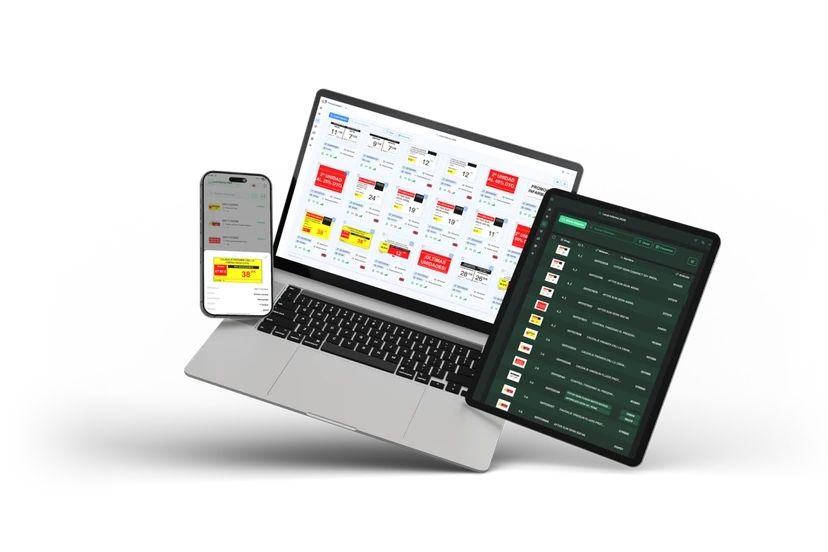
With an electronic label, the promotion is loaded with its start and end dates. The price and the offer marker appear on day one and disappear by themselves on the last. What matters is not the technology but that "remembering to take it down" no longer depends on one person.
2. Frequent price changes and till mismatches
If the management software changes a price and the shelf takes two days to catch up, the pharmacy has two prices. That gap is one of the most common sources of arguments at the counter. A label connected to the management software takes its price from the same source as the till, so the two match by design. How fast it syncs and with which software it does so must be confirmed with FarmaConnect before you count on it (see the integrations with management software).
3. Competing with online prices
The customer who says "online it's this much" already has a phone in hand. A pharmacy does not have to match every price, and many should not, but it does need to react on the few items where the comparison is direct: sun protection from a well-known brand, a mass-market laboratory's shower gel, a supplement people buy by name. Changing ten prices in an afternoon is realistic with labels; with paper signs, it is not. For guidance on what to match and what to leave alone, read how to price parapharmacy and compete with online.
4. Unit price on cosmetics
The unit price (per 100 ml, per kilo, per litre) is generally required when a product is sold by quantity, under Spain's Royal Decree 3423/2000: the selling price and the unit price must be unambiguous, easy to identify and legible, and sit in the same field of vision. For cosmetics, Annex II of the decree sets the reference unit at 100 g or 100 ml. On a dermocosmetics shelf with 30, 50 and 200 ml bottles of the same range, comparing without that figure is nearly impossible for the customer. An electronic label can show it in a small line under the price and recalculate it when the price changes. One condition: the calculation must come from a single source, not be done by hand on each label.
5. Making the offer stand out with colour
Labels with multi-colour displays (depending on the model) let you flag a discount without changing the format of the whole shelf. Available colours and sizes for cosmetics shelving need to be validated against FarmaConnect's current catalogue; for guidance on sizes, see the guide to label sizes for pharmacies.
A rule worth keeping in mind: the previous price
When you advertise a price reduction, EU price indication rules require the previous price you show to be the lowest one you applied in the 30 days before. The rule is in Article 6a of Directive 98/6/EC, applicable since 28 May 2022, and the Court of Justice of the EU reinforced it in September 2024 (Aldi Süd, C-330/23): the reduction must be calculated from that prior price, and mentioning it for information only is not enough (Baker McKenzie summary). Spain's consumer information service summarises it in similar terms (Consumo responde, in Spanish).
Here an electronic label both helps and gets in the way. It helps because, if the system keeps a price history, it can work out the previous price for you. It gets in the way if you change prices so often that "the price before" becomes hard to follow by hand. If this matters to you, the full pharmacy pricing rules are in the regulation guide. The exact wording in Spanish law and how it applies to your case should be validated with a legal adviser before you rely on a label to comply with it.
Where they add little
To be honest about the numbers:
| Situation | Value of an electronic label |
|---|---|
| Medicines with regulated retail price | Low: the price hardly changes |
| Parapharmacy with few items and stable prices | Low to medium: paper may be enough |
| Shelf with many lab promotions | High: bulk changes and automatic removal |
| Dermocosmetics with several sizes per range | High: unit price visible and consistent |
| Products compared directly with online shops | High: quick reaction on a few items |
| Pharmacy that cannot integrate with its software | Low: without a connection, you are back to changing by hand |
The last row matters more than it looks. A label with no link to the management software is an expensive sign. Before deciding, look at the integrations hub.
How to start without overcomplicating it
- Count how many changes you make a month. How many signs you swap in a normal campaign, and how long it takes. If it is very little, it may not pay off yet.
- Pick one aisle, not the whole pharmacy. The dermocosmetics or sun-care area makes a good pilot: it has promotions, prices by size and online comparison.
- Check the integration with your management software before talking about label models. It is the condition that decides whether this works.
- Decide who does what. Who loads promotions, who checks that the label price matches the till, and who answers when something goes wrong.
- Measure for a month the price arguments at the till and the hours spent on signage, and compare with the previous month. Your own measurement is worth more than any generic figure.
If your business is an independent parapharmacy rather than a pharmacy, your case is similar but has other constraints: the page on independent parapharmacies covers it. For the full picture of technology in pharmacy, start with the guide to electronic shelf labels in pharmacy. And if what worries you is mismatches between shelf and till, there is the article on price errors at the till.
Sources
- IQVIA. Evolución del mercado de la farmacia española, datos de diciembre 2025 (Spanish pharmacy market, December 2025 data)
- Real Decreto 3423/2000 on price indication for products offered to consumers (Spanish official gazette, BOE; in Spanish)
- Directive 98/6/EC on consumer protection in the indication of prices, consolidated text including Article 6a (EUR-Lex)
- Consumo responde. Las rebajas deben realizarse sobre el menor precio de ese producto durante los últimos 30 días (Spanish consumer information service; in Spanish)
- Baker McKenzie. CJEU confirms that a price reduction is calculated on the lowest price of the last 30 days (Aldi Süd, C-330/23)