What it is and what it cannot sell
In Spain, "parafarmacia" refers to health-related products that are not medicines. According to the General Council of Pharmacists' Colleges (CGCOF), dermopharmacy is the largest category, alongside medical devices (dressings, orthopaedics, self-test kits), infant products, foods for special dietary uses, and disinfectants, head-lice treatments and insect repellents (CGCOF, in Spanish).
The legal line is clear on the essentials. Article 3.6 of the consolidated Medicines Act gives "exclusively" the custody, storage and dispensing of human medicines to community pharmacies open to the public and to the pharmacy services of hospitals and health centres. There is no exception for over-the-counter medicines: without a pharmacy, you do not sell them (BOE, in Spanish).
What you can sell has its own rules, even though it never goes through a pharmacy counter:
| Category | Main rule | What it means day to day |
|---|---|---|
| Cosmetics | Regulation (EC) 1223/2009 | Every product has a responsible person and is notified before it goes on the market. Your supplier must be able to show this. |
| Medical devices | Regulation (EU) 2017/745 | CE marking and the manufacturer's labelling. You do not relabel them or change their stated purpose. |
| Food supplements | Royal Decree 1487/2009 (BOE, in Spanish) | No claims that they cure or prevent disease on the shelf, in signage or on the website. |
That last row is where shops stumble most. A sign promising that a supplement "cures" or "prevents" something can turn a freely sold product into a problem with inspectors. Check promotional wording the way you check prices.
For pricing and advertising rules in general, there is a dedicated regulation guide.
Software: the usual mistake is buying pharmacy software
Pharmacy management programs handle prescriptions, dispensing, medicine traceability and billing to the national health system. None of that exists in a parapharmacy. What it needs is what any shop with many products and thin margins needs:
- A POS that handles variants (sizes, shades, formats) and multiple barcodes.
- Stock control with expiry alerts, important in cosmetics and baby food.
- Price lists and promotions by period, with the same price at the till, on the shelf and online.
- A simple link to an online shop, if you have one.
Before signing anything, the useful question is how much of the daily work is changing prices and updating shelf information. In a shop like this, it is often the biggest share.
Competition: not the pharmacy next door
The pharmacy across the street competes on proximity and advice. The independent parapharmacy also competes with marketplaces, large chains' online stores and laboratories' own websites. In LUDA Partners' 2025 report, orders on marketplaces and laboratory sites are concentrated in babies and mothers (34%), hygiene (15%) and dietetics and vitamins (10%) (LUDA Partners, in Spanish). These are repeat-purchase categories with prices that are easy to compare on a phone, and they are also the ones that attract the most promotions.
Two practical consequences:
- Prices are compared at the shop door. A customer checking a phone beside the shelf finds someone else's price and, if your label does not match the till, loses trust before you lose the sale.
- You must decide which products to watch. Fixing a small group of comparison items, the ones customers know by heart, and leaving the rest with margin is a more sustainable policy than chasing every price.
If you discount, the discount must respect the reference-price rules, explained with sources in the 30-day reference.
Electronic shelf labels: when the numbers work
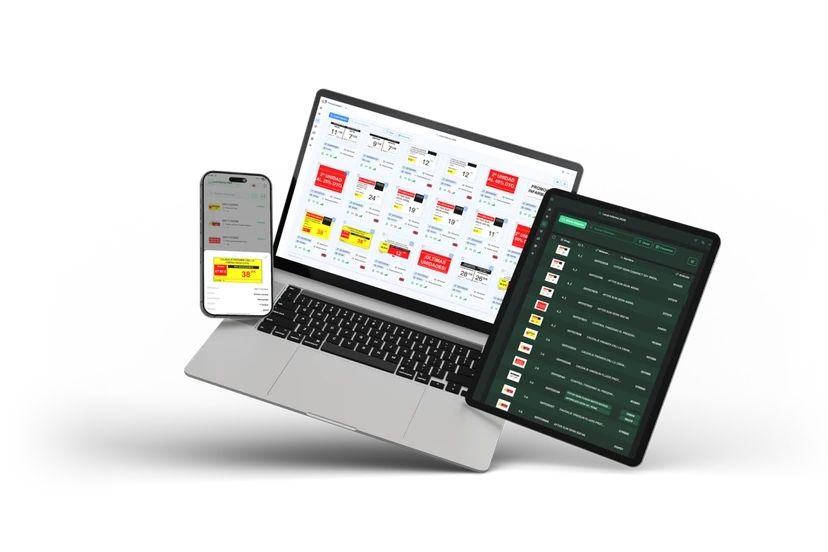
An electronic shelf label is a low-power display on the shelf whose price is updated from the system, with no printing or sign changes. If the concept is new to you, the general guide explains it without reference to any vendor.
In an independent parapharmacy the case for them rests on three things: many products, frequent price changes and few staff. If one is missing, the case weakens. A shop with 800 stable products run by two people may need nothing more than a good POS. One with several thousand products, weekly promotions and prices tuned to online rivals can have a manual update cost worth measuring.
The sensible approach is to calculate with your own data: products, changes per month, minutes per change and errors caught at the till. The total cost of ownership calculator is built for that sum.
A point of honesty about our own case: farmaconnect.es focuses on community pharmacies. We cannot yet confirm that the FarmaConnect system can be installed in a premises without a pharmacy, or which retail POS it would connect to, so this page does not present it as a solution for this profile. If you are interested, ask before you decide.
If you run a pharmacy with a parapharmacy section
That is a different situation. The management software, the pharmacist and the dispensing rules are all there, and the parapharmacy shelf is one part of the business, not all of it. That case has its own page: parapharmacy inside the pharmacy. And if the difference you care about is setting (village or city), see urban and rural pharmacy.
Selling online: what is and is not allowed
A parapharmacy can run an online shop with its own products. It cannot include over-the-counter medicines. Royal Decree 870/2013 limits distance selling of these medicines to "community pharmacies open to the public and legally authorised" that have notified the activity, and requires a pharmacist to be involved in the sale (BOE, in Spanish). A parapharmacy's website should also identify its owner as any e-commerce business must, and honour the 14-calendar-day right of withdrawal that Spanish consumer law grants on distance sales (BOE, in Spanish).
If the business has both a shop and a website, the most important digital challenge is that price, stock and description of every item are the same in both channels.
Where to start
- Measure. Count products, price changes per month and minutes per change. Without that figure, any quote is opinion.
- Tidy the catalogue. Clean barcodes, categories and suppliers before connecting anything.
- Review the wording. Signs, website and social media with no health promises the product cannot support.
- Pilot one area. If you decide to automate prices, start with a high-turnover category and write down when you will call it a success or stop.
Sources
- BOE. Real Decreto Legislativo 1/2015, texto refundido de la Ley de garantías y uso racional de los medicamentos y productos sanitarios (art. 3)
- BOE. Real Decreto 870/2013, de venta a distancia al público, a través de sitios web, de medicamentos de uso humano no sujetos a prescripción médica
- CGCOF. Parafarmacia: qué son los productos que no son medicamentos
- LUDA Partners. III Informe de Venta de Parafarmacia Online 2025
- EUR-Lex. Regulation (EC) No 1223/2009 on cosmetic products
- EUR-Lex. Reglamento (UE) 2017/745 sobre los productos sanitarios
- BOE. Real Decreto 1487/2009, relativo a los complementos alimenticios (art. 4)
- BOE. Real Decreto Legislativo 1/2007, Ley General para la Defensa de los Consumidores y Usuarios (art. 102 y ss., desistimiento)