Why it happens so easily in a pharmacy
A Spanish pharmacy runs two price worlds over the same counter. Reimbursed medicines, and a good part of other medicines, follow a calendar the owner does not control: the price billed to the National Health System is the one in each month's Nomenclátor (the official medicines price list), according to the Ministry of Health's note on homogeneous groups, and the reference price system is revised by ministerial order. Parapharmacy follows the calendar of manufacturers and campaigns, and there each pharmacy sets its own price.
That mix is why the errors differ from a supermarket's. In a supermarket the problem is usually volume: thousands of lines and constant changes. In a pharmacy the volume is lower, but the team is small, the counter is busy most of the day, and changing a shelf ticket competes with serving the person waiting. Small errors pile up precisely because nobody has a quiet moment to check.
Four underlying causes
1. The promotion that ended, but the ticket does not know
In parapharmacy this is the one to check first, because it is the only case where the price changes on a calendar without anyone touching anything. A sun-care range on a 2-for-1 until 31 August, or a 3-for-2 on dermocosmetics for three weeks, has an end date in the management software. The paper ticket never hears about it. The next day the customer sees the offer price and the till charges the standard one. The argument that follows is not about euros; it is about who is right, and the ticket usually wins.
The opposite also happens: the offer is extended at the till for a couple of days because the manufacturer warned late, and the ticket has already been taken down. That is easier to settle, since the customer pays less than advertised, but it leaves a price with no visible backing and muddies any later comparison.
2. The PVP update that does not reach every place
When the Nomenclátor changes a medicine's price, the management software picks it up with its update. If the shelf ticket, or a printed counter list, was made earlier, it keeps the old price. This mostly affects products displayed with a price: over-the-counter medicines on open sale, medical devices and some EFP products (health-related products sold alongside medicines). The difference between the PVP and the selling price of an EFP product has its own article: EFP and PVP: what is the difference.
3. The handwritten ticket
Writing a price by hand, or reusing a template with last campaign's price, is the hardest error to spot because it leaves no trace. There is no change in any system to audit: only a piece of paper with a number. A 9.95 that should have been 8.95, a unit price worked out wrongly, a misplaced decimal. While the ticket is the only copy of the data, any transcription error is published as it stands.
4. Several places where the price is stored
When the price lives in the management software, in a spreadsheet for the tickets and in the head of whoever does the signage, disagreement is a matter of time. Nobody needs to make a mistake: two people updating at different moments is enough. The pattern is the same in any shop, so it is worth having the principle clear before getting into pharmacy details: one single price source, and everything else derived from it.
What can happen when the customer notices
It helps to separate three scenarios, from least to most serious.
The complaint at the counter. This is the usual one. The customer points at the ticket, the charge is corrected and that is that. It costs a minute of awkward conversation, but it repeats: a pharmacy where this happens often starts to look careless, and trust in prices matters a great deal with regular customers.
The formal complaint. If the customer is not satisfied, they can ask for the complaints form (hoja de reclamaciones) or go to the consumer office. The general rule is demanding on price information: the consolidated text of the General Law for the Defence of Consumers and Users (art. 20) requires the full final price, taxes included, to be shown in clear and truthful terms, and Law 7/1996 on retail trade (art. 20) governs price-reduction offers. Which price prevails when shelf and till differ, and how discrepancies are treated in retail generally, is explained in the etiquetaselectronicas.io reference on shelf and till prices; we do not repeat it here.
The penalty file. Breaching the rules that govern prices is listed among the consumer infringements in art. 47 of the consolidated text, and minor fines range from 150 to 10,000 euros (art. 49.1), with higher tiers for serious cases. The autonomous regions hold inspection and sanctioning powers, so the practical approach depends on where the pharmacy is. As a historical reference, in 2001 the Murcia regional consumer authority opened cases against some fifty supermarkets for charging at the till prices different from those displayed, and did not accept stock errors as an excuse; it is an old case and about large retail, but it shows how inspections work: a mystery shopper and a basket of products.
None of this makes pharmacies a special target. What they do have is a particular consequence: a customer who doubts the parapharmacy price starts to doubt the rest too, including what they cannot compare.
A checklist to prevent it
None of these measures needs technology. A sheet of paper and a calendar already cut a good part of the problem; technology only removes the manual part.
- Decide who is in charge. The price that comes out of the till is the price. The ticket derives from it, never the reverse.
- Record every promotion with its end date in a shared calendar, the same day it is entered in the management software. If an offer has no end date, it gets no ticket.
- Give one person and one time slot to the takedown. Whoever removes tickets for offers that end is a named person on a named day of the week. "Whoever walks past" is the recipe for failure.
- Check after each Nomenclátor update the tickets and lists that show a PVP product price. It is a short check: only what is signed with a figure.
- Run a ten-minute weekly audit. Pick ten ticketed products at random, scan them at the till and note differences. When the difference is zero for a month, lengthen the interval.
- Log the changes. Who changed which price and when. When a complaint arrives, the first thing to know is whether it was a process failure or one person's slip, and without a log you cannot answer.
- Prepare the reply before you need it. What is charged if ticket and till differ, who decides, how to apologise. A three-line guideline avoids improvising with a queue waiting.
- Check the unit price where it applies. Royal Decree 3423/2000 requires it next to the selling price on products that call for it; if a person works it out for the ticket, that is one more point of error.
Where technology helps and where it does not
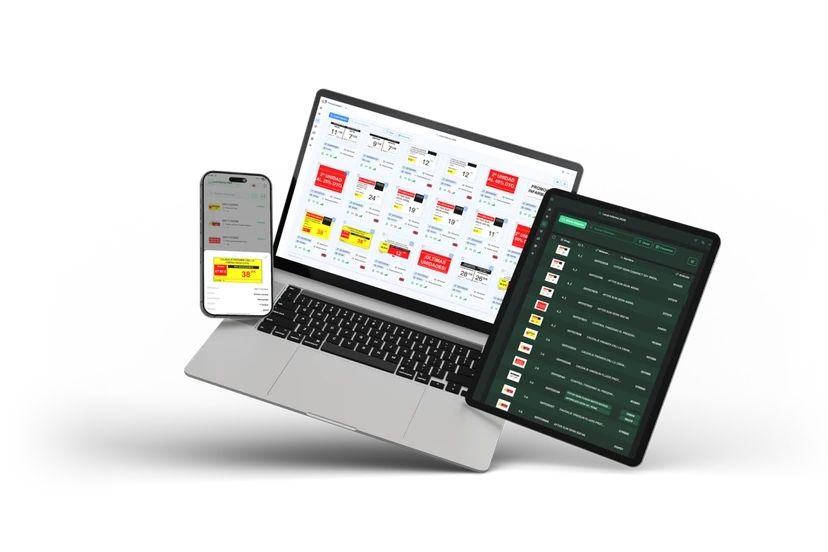
An electronic shelf label connected to the management software removes causes 1, 3 and 4 above in the most literal sense: the price is read from the same place as the till, and a promotion with an end date can be scheduled to end by itself. It does not remove the error at source: if the price is wrong in the management software, it will be wrong in both places, consistently. Nor does it replace the audit, because a label still needs someone to check that it sits on the right product.
How labels work in a pharmacy is covered in the electronic shelf labels guide for pharmacies; for parapharmacy, with promotions and unit prices, see the parapharmacy labels service. If your concern is what may be advertised in the shop and what may not, there is the guide to pharmacy pricing and advertising rules, and for in-store screens, the digital signage guide.
We have not included figures for how many pharmacies suffer these discrepancies or what they cost, because we found no reliable source measuring them in the sector. The most useful thing is to measure it in your own pharmacy: ten products, one week, and you will know whether there is a problem.
Sources
- Real Decreto Legislativo 1/2007, texto refundido de la Ley General para la Defensa de los Consumidores y Usuarios, arts. 20, 47 y 49 (BOE, texto consolidado)
- Ley 7/1996, de Ordenación del Comercio Minorista, art. 20 (BOE, texto consolidado)
- Real Decreto 3423/2000, sobre indicación de los precios de los productos ofrecidos a los consumidores y usuarios (BOE)
- Real Decreto 177/2014, sistema de precios de referencia y agrupaciones homogéneas de medicamentos (BOE, texto consolidado)
- Ministerio de Sanidad: gestión de agrupaciones homogéneas y precio de facturación según el Nomenclátor de cada mes (2012)
- Consumer.es: Consumo multa a 50 supermercados por cobrar precios diferentes a los marcados en etiquetas (2001)