What is what
Several very different kinds of organisation sit under the word "group". They are worth separating, because they ask different things of in-store signage.
| Type | Public examples | Mainly does |
|---|---|---|
| Distribution cooperative | Cofares, Hefame, Bidafarma | Wholesaler owned by pharmacists; daily logistics |
| Buying and services group | Fedintia (within Fedefarma), Iconika | Negotiation with manufacturers, campaigns, training |
| Brand or banner network | Alphega Farmacia, Iconika | Common image, loyalty club, shared promotions |
The sizes each organisation publishes cannot be compared with one another, and several are dated. According to its website, Iconika has 849 member pharmacies and more than 80 agreements with manufacturers. Alphega Farmacia gives a figure of more than 900 member pharmacies across Spain; that is what it publishes today, and the number has moved over the years. We found no current, confirmed number for Fedintia: it began as the buying group of Federació Farmacèutica, and its parent cooperative speaks of around 3,000 members in Catalonia and the Valencian Community, without saying how many belong to Fedintia. On the distribution side, according to Forbes España, Cofares turned over EUR 4,580 million in 2025, Bidafarma exceeded EUR 3,200 million and Hefame reached EUR 1,929 million; Bidafarma serves more than 10,800 pharmacies.
For scale: Spain ended 2025 with 22,273 community pharmacies, according to figures the CGCOF, the national pharmacists' council, published on 30 June 2026. A banner network of around 900 pharmacies is therefore roughly 4% of the total. Distribution cooperatives play in a different league: Bidafarma alone serves more than 10,800, close to half the pharmacies in the country. The cooperative reaches far more pharmacies, but it is usually the banner network that sets the campaign calendar.
What a group shares and what it does not
Spain has no pharmacy chains of the kind found in other countries, because ownership of a pharmacy is reserved to pharmacists (Law 16/1997). That shapes everything that follows. A group cannot give orders to each shop; it negotiates, proposes and facilitates.
Shared, with caveats:
- The campaign calendar: which category is pushed each month (sun care, hair loss, vitamins, flu) and with which manufacturer.
- The purchasing terms negotiated, which explain the discounts and promotions that each member then passes on to the customer or not.
- A loyalty club or common card, where there is one. Alphega Farmacia offers Mi Club Alphega, and Iconika mentions a Club Iconika.
- Branding and point-of-sale materials, which in the more closed brand models range from shopfront signs to furniture.
Not shared:
- The retail price of parapharmacy, which each owner sets. The price of reimbursed medicines is set by the authorities, so there is no commercial decision to make.
- The management software: one network can include pharmacies running software from different vendors, each with its own way of exporting prices and product codes.
- The actual pace of execution. A group announcing a campaign on the 1st does not mean the signage is up on the 1st in every member pharmacy.
That last gap is where a group tends to lose money without noticing: the manufacturer pays for a display, but nobody knows in how many shops it was actually carried out.
The operational problem of a group
A group does not have the problem of a pharmacy with more scale. It has a different one.
Synchronising without centralising. A manufacturer's 2-for-1 promotion across a network of several hundred pharmacies means changing prices and shelf signs in all of them, with national product codes that must match each shop's catalogue. In a single pharmacy, one person does this between two dispensings. In a group, either there is a process each pharmacy can run with little effort, or it goes undone in half the cases.
Proving compliance. If the manufacturer funds the display, the group needs to know which pharmacies set it up. Today that information is usually a photo sent by an assistant, or a site-visit audit.
Respecting autonomy. Any tool that gives the group the key to a member's pricing runs against the group's own model. If the proposal is that the group changes prices on everyone's labels, the honest answer from many pharmacies will be no. What does fit is for the group to prepare the campaign and each pharmacy to accept it with a single action.
This matches the caution we describe for the case of an urban or rural pharmacy: the value of a label depends less on size than on who changes the prices and how much they change.
What digital signage and shelf labels can offer
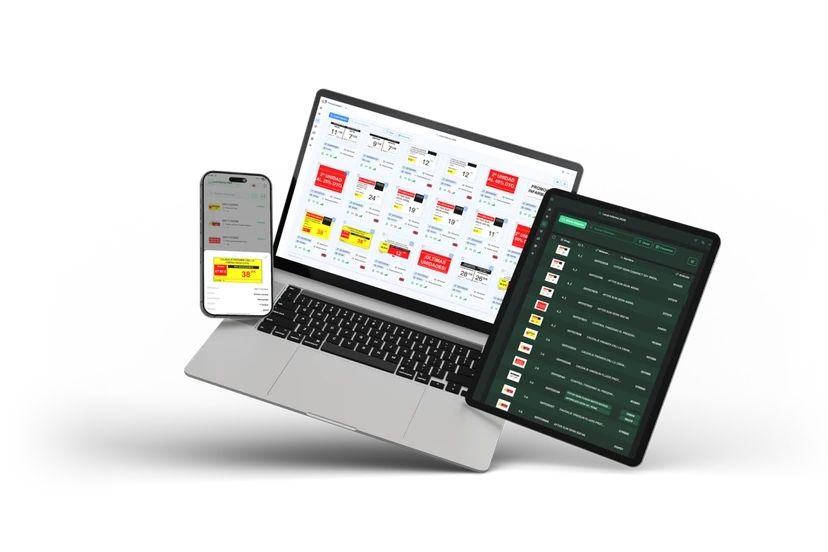
The idea is simple. A platform that manages several points of sale could receive a campaign defined by the group and present it to each pharmacy for approval. The label or screen then changes, and the platform records that the change took place. That would solve the lack of traceability.
What to check before treating it as a solution:
- Per-pharmacy permissions. The group should be able to propose and the owner to decide. If the platform does not distinguish the two levels, it does not suit this channel.
- Integration with each management system. If the network uses several, the cost of integrating each one can exceed the cost of the labels. FarmaConnect does not state any compatibility here; the company has to confirm that.
- Cost per pharmacy. Groups negotiate well, but an independent pharmacy will not sign a recurring expense without seeing a return. Group purchasing of hardware only helps if the fee per pharmacy is clear and fixed.
- What happens offline. If the pharmacy loses its connection, it must still be able to change prices in the shop.
If you want to understand what an electronic shelf label is before assessing this channel, the basic guide to electronic shelf labels explains it without reference to any sector. To work out the total cost of a multi-store project, there is a total cost calculator in the neutral category reference, and its explanation of how to run a pilot applies as much to a single pharmacy as to a network.
On-screen content: where the limit lies
A group that coordinates signage and screens operates in a regulated area. Royal Decree 1416/1994 provides that only medicines expressly classed as advertisable, meaning those used without medical diagnosis or prescription, may be advertised to the public. Prescription medicines, those containing psychotropic or narcotic substances, and those reimbursed by the National Health System are excluded. It also prohibits the direct distribution of medicines to the public for promotional purposes.
The practical consequence for a shared campaign: displays of parapharmacy, dermocosmetics and over-the-counter products are the natural ground for collaboration with manufacturers; medicines need prior review, and the pharmacist is answerable for the counter. If the group prepares the central content, that review should be part of the workflow, not left to each shop.
Promotional price information in a pharmacy follows the same rules as in any shop. On the 30-day reference price, which affects discounts, there is an analysis of the 30-day rule in the neutral category reference; in a pharmacy it applies to parapharmacy and to medicines with free pricing, not to reimbursed ones.
What we do not know yet
This page describes the channel from public sources. It does not say that FarmaConnect works with any of the groups mentioned. Nor does it say the platform was designed for a network of independent pharmacies: the company has to confirm that. We also lack current figures for several groups, and some of those published are years old; where a source gives no figure, we leave it out.
If you run a group or a cooperative and want to assess this channel, the sensible starting point is a conversation about a limited pilot, which you can start from the FarmaConnect home page. And if your organisation brings together shops that are not pharmacies, the reference on retail cooperatives covers that case.
Sources
- Iconika. Official website: 849 member pharmacies, more than 80 agreements with manufacturers, Club Iconika
- Alphega Farmacia. Official website: more than 900 member pharmacies in Spain, Mi Club Alphega
- Farmaventas. IV Encuentro FedintiA (22-02-2012): Fedintia as the buying group of Federació Farmacèutica
- IM Farmacias. Fedefarma, más de 95 años al servicio de la farmacia (2024): 3,000 members in Catalonia and the Valencian Community
- Forbes España. La logística farmacéutica crece con Cofares y Bidafarma (18-08-2026)
- BOE. Real Decreto 1416/1994, regulating the advertising of medicines for human use
- BOE. Ley 16/1997, de 25 de abril, de Regulación de Servicios de las Oficinas de Farmacia (consolidated text)
- CGCOF. Farmacéuticos colegiados 2025 (30-06-2026)